
Picture this: You walk into an exam room. Your patient is sitting on the table looking anxious. You make eye contact, shake their hand, and start the conversation. Your phone stays in your pocket. Your computer stays closed. Your hands are free to examine, gesture, and connect.
And somehow, the entire visit gets documented. Labs get ordered. Follow-ups get scheduled. The patient walks out with a complete visit summary texted to their phone. No typing. No clicking. No breaking eye contact to stare at a screen.
Sounds like science fiction? It's closer than you think.
The Ambient Scribe Problem
Ambient scribes are having a moment. Every EHR vendor and startup is launching one. The pitch is simple: your phone or computer listens to the visit, transcribes everything, and generates a note. And honestly? It's better than typing everything yourself. But here's what nobody talks about: you're still managing a device during the patient visit.
You pull out your phone to start recording. You glance at the screen to make sure it's working. You worry about whether it caught that important detail. You end up half-focused on the patient and half-focused on the technology.
The form factor is wrong! In clinical settings, form factors matter more than people realize. Your hands need to be free for examinations. Your attention needs to stay on the patient. Anything that competes for your focus during a visit is a problem. Plus, ambient scribes only do one thing: create a note. They don't help with the dozens of other tasks that happen during a visit. A human scribe would be ordering labs, scheduling follow-ups, pulling medication lists, documenting vitals. Current AI scribes? They just listen and type.
That's useful. But it's not enough.
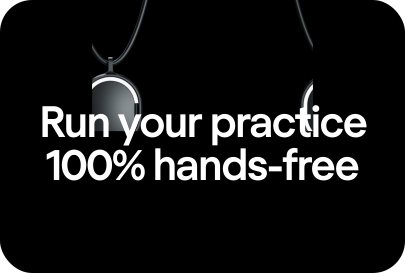
What If Your Scribe Was Around Your Neck?
Wearable technology has been promising to change healthcare for years. Patients wear devices that track everything. But what about doctors? What if your AI scribe wasn't an app on your phone? What if it was a wearable device around your neck or clipped to your coat? Always on. Always listening. Always ready.
Your hands stay free. Your eyes stay on the patient. The technology fades into the background instead of demanding your attention. This isn't just about convenience. It's about being present. Actually present.

Cline Wearable Device - Demo Image
A Day in the Life (Coming Soon)
Here's what the future looks like:
You show up for work. At home, at the clinic, at the hospital. You log into your computer and activate your digital clone AI agent. This agent has its own NPI associated with yours.
The agent starts checking in patients and screening records to coordinate your schedule. You grab your wearable and put it around your neck. The agent pairs with the wearable. It uploads patient data for your daily schedule.
You walk into the first exam room.
The wearable is recording and transcribing in real time. But more importantly, it can respond. Your patient can't remember the name of their medication. You ask your agent. It tells you immediately. The medication name, who prescribed it, when they started taking it.
The visit wraps up. Your agent orders labs and schedules the follow-up visit while the patient is still in the room. The patient confirms the appointment. As they walk out, they receive a text with the complete visit summary. Your agent tells you the documentation is ready. You review it quickly or tell it to submit. Either way, you're done.
You grab a coffee before seeing your next patient.
Why Voice Changes Everything
Current ambient scribes listen. Wearable scribes need to talk back.
This matters more than it sounds. In real clinical workflows, you need verification. You need clarification. You need information pulled up immediately. If your scribe can only listen, you're still reaching for your phone or computer when you need answers. The wearable becomes pointless if it can’t talk back.
So what happens when your scribe can speak to you? Everything changes.
The patient forgets a detail about their medical history? Ask your agent. It responds instantly. Completely hands-free.
Need to confirm a drug interaction before prescribing? Ask your agent. It checks and tells you out loud.
Want to explain something to a patient but need to reference their last lab results? Your agent can tell you without breaking the conversation flow.
And here's a bonus: translation services. Your wearable agent could translate between you and a patient in real time. No phone. No tablet. Just seamless communication.
Beyond Note-Taking
The real power of a wearable scribe isn't just documentation. It's automation of every task that currently steals your attention during patient care. A human scribe doesn't just write notes. They manage the visit workflow. They anticipate what you need. They handle administrative tasks so you can focus on medicine.
That's what AI should do.
Your wearable agent should be ordering labs as you mention them. Scheduling follow-ups as you recommend them. Updating medication lists as you prescribe. Sending patient education materials as you discuss treatment plans. All of this happening in the background. All of this is handled without you touching a computer.
The Customization Problem
Here's where current scribes fall short: they're one-size-fits-all. Every doctor works differently. Every specialty has different documentation needs. Every practice has different workflows. But ambient scribes give you what they give everyone else. Generic templates. Standard formats. Limited customization.
What if you could build your own AI scribe agent?
Design exactly how it documents your visits. Program exactly what tasks it automates. Customize exactly how it responds to your requests.
A psychiatrist needs different documentation than an orthopedic surgeon. A pediatrician has different workflow needs than an internist.
One product can't serve everyone. But a platform that lets doctors build their own? That works for everyone.
Built Native to Your EHR
The other problem with current scribes: they live outside your EHR. You record in one app. Review in another app. Then copy and paste into your EHR. Maybe there's an integration. Maybe it works. Maybe it doesn't.
Wearable scribes need to be built directly into your EHR environment. Not bolted on afterward. Not integrated through some fragile API connection. Native.
When your scribe is EHR-native, it can do things external apps can't. It can pull patient data instantly. It can write directly to the chart. It can trigger workflows in your practice management system. And it's HIPAA compliant by default. No third-party security concerns. No wondering if your data is being used to train someone else's models.
What Doctors Actually Want
Strip away all the buzzwords and here's what doctors want: more time with patients and less time with computers. They want to practice medicine the way they were trained. Looking at patients. Listening to patients. Examining patients. Not staring at screens. Not clicking boxes. Not typing notes at midnight.
Technology should enable that. Not get in the way of it.
Wearable scribes that are voice-enabled, task-automating, and EHR-native get us closer to that reality. Technology that disappears. Workflows that flow. Attention that stays where it belongs.
Video Demo of Cline Scribe
The Future Is Wearable
We've been promised AI that changes healthcare for years. Most of it has been disappointing. More software to learn. More screens to manage. More friction added to already broken workflows. But wearable technology changes the equation. The form factor finally makes sense. The interaction finally feels natural. The automation finally happens in the background.
Your scribe isn't an app competing for your attention. It's a tool that works invisibly while you focus on what matters.
That's the future Cline is building. Not another ambient scribe app. A wearable, voice-enabled, customizable scribe agent that you design for your exact needs. Built natively into your EHR. Automating the tasks that steal your time. Because the best technology isn't the most impressive. It's the technology you forget you're using.
Ready to Become a Builder?
Cline's EHR-native platform lets doctors design and build custom apps and AI agents, including wearable scribes, without needing developers or engineers. Built for doctors, by doctors. Secure, compliant, and completely customizable.
Stop adapting to someone else's workflow. Start building your own