
If you've ever spoken to a doctor in the U.S., you've probably heard these exact words: "I wish I could clone myself." It's no secret. There aren't enough doctors to go around. Roughly 250 doctors for every 100,000 patients. Fewer students choosing medicine. More doctors retiring early. And a projected shortage of up to 86,000 physicians by 2036. The supply problem isn't going away. If anything, it's getting worse.
The AI Doctor Debate
Many believe the solution is AI doctors. Companies and investors are betting billions on this approach, with some taking aggressive stances.
8VC recently published an article arguing that regulation is keeping AI from advancing in healthcare and that AI should be able to bill for services as it operates autonomously treating and managing patients.
Other companies like Doctronic and Counsel are taking a different route. Instead of full autonomy, they're creating AI-native practices where doctors use AI to deliver clinical services while keeping humans in the loop.
Here's the interesting part: most doctors and patients aren't asking for autonomous AI. According to Offcall's survey of 1,000+ physicians, 87% don't fear AI taking their jobs. Their primary request? Help with clinical documentation and administrative tasks, not replacement of direct patient care.

The Doctors Digital Twin Interface
A Different Vision: The Doctor's Digital Twin
At Cline, we see the world differently. We believe doctors should have access to the same models that companies like Doctronic and Counsel use, but with one critical difference: doctors build them for themselves.
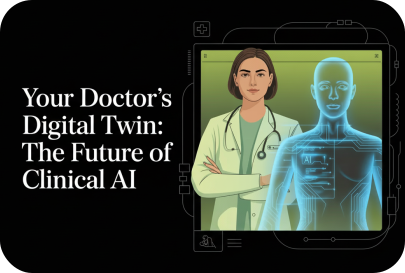
This is what we call the Doctor's Digital Twin. Your AI clone. Trained on your clinical approach, your patient population, your protocols. Semi-autonomous, with you and your staff as the human in the loop guiding patient care.
Unlike off-the-shelf solutions, you design and build your digital twin to your specifications. Your specialty. Your context. Your memory. Your training scenarios. That control matters. Because doctors are risk-averse. Unknowns discourage adoption of new technology. But when you build it yourself? When you can monitor every action your digital twin takes with real-time alerts? Trust follows.
What Your Digital Twin Can Do
Your digital twin extends your reach without replacing your presence. Here's what doctors are already building:
A 24/7 chatbot in your patient portal answering routine questions. Website guidance walking prospective patients through services, scheduling, intake forms, and qualification quizzes. Pre-visit evaluation summaries ready before appointments. Insurance eligibility management. The first point of contact for patients arriving with ChatGPT printouts. Automated messaging, rescheduling, payment management, record processing. Health record data integrations with other EHR systems.
Dr. Clone: A Real Example
Cline created a use case we call Dr. Clone Template. It's a chatbot that responds via voice and image using an AI avatar mirroring the doctor's likeness.
The scenario: A patient chats with their doctor's digital twin requesting an appointment change and confirmation on medication instructions.

The setting: Inside the doctor's EHR patient portal, embedded directly in messaging.
Because it's EHR-native, there's end-to-end automation. The digital twin collaborates with other agents to reschedule appointments and confirms medication instructions written in the patient's medical note by the doctor. No guessing. No generic information. Limited hallucinations. Reduced risk.
Why This Matters Now
Clinical AI is being built right now. Multiple companies are actively developing it. Autonomous AI managing patient care will happen with or without doctors' approval.
Our argument at Cline: Clinical AI is safer when doctors build and manage it in-house through vibe-coding. The reason is simple. Doctors are licensed to treat and manage patient care. They take an oath to do no harm.
We can't say the same about startups and investors. They have obligations to shareholders and lending partners motivated by investment returns, not whether patients will do better with or without a certain treatment or technology.
Research shows patients value the emotional connection with physicians and express concerns about AI's inability to perceive emotions. Patients trust physicians more than AI and prefer human involvement in treatment decisions, even when acknowledging AI's superior accuracy.
When doctors build their own digital twins, adoption follows trust. When trust exists, technology gets used instead of ignored.
The Trust Problem
Here's what patients are saying. Patients want physicians to ensure AI safety and prefer their doctors to make treatment decisions and oversee ongoing care. They believe they should have the right to decide if AI tools are used in their care and to correct AI recommendations they believe to be inaccurate.
Patients are uncomfortable relying entirely on AI-generated recommendations without the ability to independently assess the reasoning behind those suggestions.
The solution? Give doctors the tools to build AI they trust. Monitor it. Control it. Modify it. That's how you increase adoption while maintaining safety.
Building vs. Buying
Digital twins are coming to healthcare whether we're ready or not. The question isn't if, but who builds them and who controls them. You can wait for vendors to sell you their version of what they think you need. Generic solutions. Limited customization. Monthly subscriptions that add up. Or you can build exactly what your practice needs. Your protocols. Your patient population. Your workflows. Your voice.
Cline's EHR-native vibe-coding platform makes this possible without requiring software engineering skills. Build custom apps, websites, agents. All HIPAA compliant. All under your control. Because the best person to design how AI works in your practice isn't a product manager in Silicon Valley. It's you.
The Choice Ahead
The doctor shortage is real. The burnout is real. The administrative burden is crushing.
AI can help. But only if it's built right. By the people who understand medicine. By the people who've taken the oath. By doctors.
Your digital twin isn't about replacing you. It's about extending you. Expanding what you can do. Reaching more patients. Reducing the burden. But it has to be yours. Built by you. Controlled by you. Trusted by you.
That's the future Cline is building.
Ready to Build Your Digital Twin?
Follow us to learn how Cline's EHR-native platform lets you create your own AI clone to support clinical care and administrative tasks. No coding required. Full control. Complete trust.